
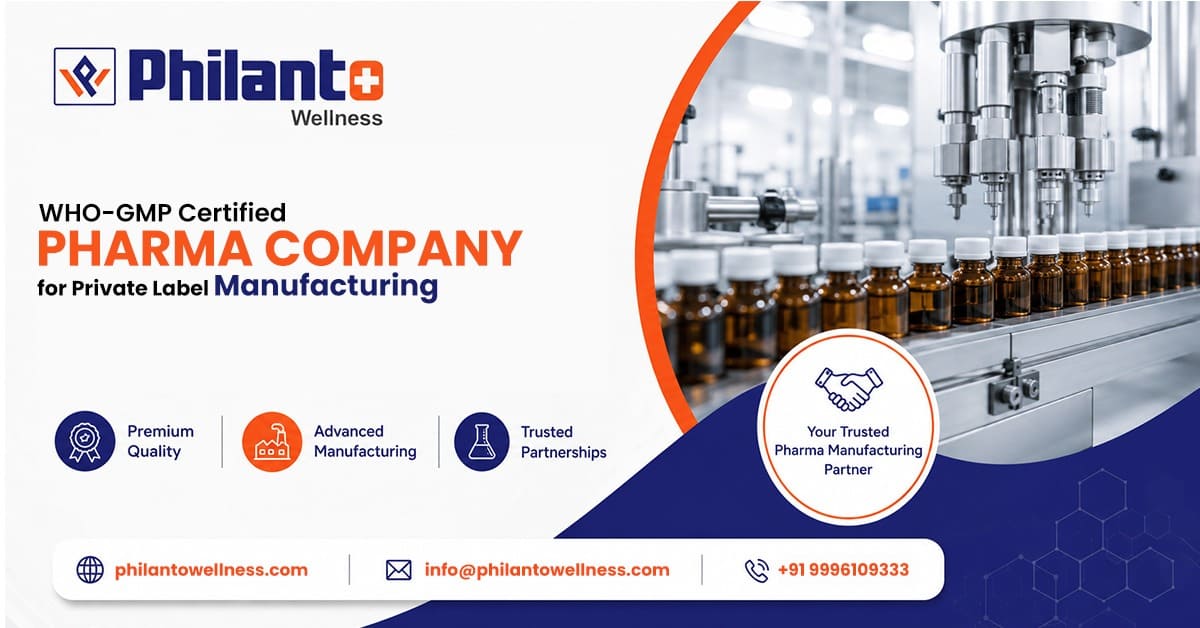
Private label pharmaceutical manufacturing is the best solution for many businesses that want to introduce medicines, nutraceuticals, and wellness products under their own brand name, without actually building a production facility. But picking the right manufacturing partner matters a lot, because product quality, regulatory compliance, formulation skills, packaging quality, and dependable supply all affect whether the private label brand will really take off or not. Also, a WHO-GMP pharma manufacturing company tends to bring a more structured production space, with recorded procedures and quality-control systems that stay consistent. If you’re aiming to launch your own pharmaceutical or wellness brand, teaming up with an experienced manufacturer like Philanto Wellness can make the whole “from concept to shelves” process easier, while you focus on your market, your positioning, and the brand launch needs.
What is private label pharma manufacturing?
Private label pharma manufacturing is a business arrangement in which a manufacturer especially focuses on producing pharmaceutical or healthcare products for another company. As a result they market and sell them under their own brand name.
The private-label partners typically concentrate on the following:
- Brand development
- Product selection
- Marketing and distribution
- Packaging and branding requirements
- Market expansion
Additionally, the manufacturing company oversees various activities, including the following:
- Product manufacturing
- Raw material sourcing
- Quality testing
- Production documentation
- Packaging
- Batch processing
- Product dispatch
This model therefore allows businesses to build their own healthcare brand without investing in a complete manufacturing plant.
Why is WHO-GMP certification important?
WHO-GMP is a shorthand for good manufacturing practices, built on standards and guiding principles that the world health organization developed. It’s mainly about making sure medicines are produced and checked often, in line with the right quality benchmarks. So even if a private-label company is operating with these requirements, a WHO-GMP-compliant manufacturing setup may still deliver a number of benefits, you know, in a real-world way like:
- Manufacturing processes that are controlled
- Production steps that are standardized
- Quality-control systems in place
- Documentation that’s accurate, plus traceability that works
- Better care for starting materials and for finished goods
- Less likelihood of manufacturing variations or inconsistencies
- More trust, both with business partners and with customers
In the end, companies should not just accept advertising statements, they should check the manufacturer’s current certifications and, importantly, the precise scope of its manufacturing approvals, so they are sure what’s actually covered and what’s not.
How does private label pharma manufacturing work?
The private-label manufacturing process generally follows several stages like:
- Product Selection: First, the brand owner selects the specific therapeutic category, dosage form, strength, target audience, positioning, and overall product line requirements.
- Formulation & Product Development: The manufacturer reviews the required formulation and evaluates its production feasibility, regulatory requirements, and any necessary formulation adjustments.
- Packaging & Branding: The business finalizes the brand name, packaging design, labels, cartons, bottles, and other presentation elements while ensuring compliance with applicable labeling regulations.
- Raw Material Procurement: The manufacturer sources APIs, excipients, packaging materials, and other required components through its established supplier and procurement network.
- Manufacturing: A WHO-GMP Pharma Manufacturing Company produces the products using documented processes, quality standards, and controlled manufacturing procedures to maintain consistent batch quality.
- Quality Testing: Raw materials, in-process materials, and finished products undergo appropriate quality testing. Products proceed only after meeting the required quality specifications.
- Packaging and Batch Processing: After approval, the products are packed and labeled with accurate batch numbers, manufacturing details, expiry information, and other required product information.
- Final Release and Dispatch: Following quality review and documentation verification, the finished products are released and dispatched to the private label brand owner for marketing and distribution under their own brand.
- Building Greater Trust: A well-managed private label manufacturing process helps strengthen trust between business partners while supporting consistent product quality and customer confidence.
What products can be manufactured by a reliable WHO-GMP pharma manufacturer in India?
The list of product categories that can be made depends on what they actually can handle inside their facilities, what permits are available, what product approvals are in place, and what they decided to focus on. Still, private label manufacturing options can vary a lot from one company to another, but they often cover things like:
- Tablets
- Capsules
- Softgel Capsules
- Syrups and Oral Liquids
- Dry Syrups
- Nutraceuticals
- Dietary and Nutritional Supplements
- Protein and Wellness Products
- Herbal and Wellness Formulations
- Dermatology Products
- General Pharmaceutical Products
- Other Specialized Healthcare Formulations
What are the benefits of choosing a WHO-GMP pharma manufacturing company?
Choosing a Reliable WHO-GMP pharma manufacturer in India can bring a bunch of practical benefits you can feel in your day to day planning.
- Quality-focused systems lean into controlled manufacturing, proper documentation, hygiene routines, ongoing testing, and steady workflows so nothing drifts off track.
- Lower infrastructure spending: With private label models, you can avoid the major capital investment required to build your own manufacturing plant, equipment, laboratory, and complete production setup.
- Faster brand building: A seasoned manufacturing partner can help streamline product selection, production schedules, packaging processes, and supply coordination, sometimes even faster than doing it in-house.
- Customized branding: Companies can shape their own brand identity using suitable product names, packaging designs, and labeling, while ensuring compliance with applicable rules and regulations.
- Scalability: Once a product starts gaining traction in the market, there is an opportunity to expand the portfolio and increase production volumes through the same manufacturing partnership.
- Professional manufacturing support: The right manufacturer can provide technical and day-to-day operational assistance throughout the manufacturing process and during product supply.
How to pick the best private label pharma manufacturing company?
Before you lock in a partner, take a close look at a few key things, not just the glossy pitch.
- Manufacturing Credentials: Check the relevant licenses and certifications, along with the facility details, to ensure the manufacturer meets required industry standards.
- Quality Systems: Get clarity on how they monitor and control raw materials, production processes, testing procedures, and finished goods.
- Product Portfolio: Choose a manufacturer whose product offerings align with your target market and business requirements without significant gaps.
- Minimum Order Quantity: Confirm the MOQ for each product early so you can plan your investment and inventory requirements accordingly.
- Customization Options: Ask about available customization for formulations, dosage forms, packaging styles, and branding support.
- Packaging Quality: Check the packaging formats available and clarify how labeling support is managed, including responsibilities for design, printing, and application.
- Production Capacity: Ensure the manufacturer can meet your current requirements and handle future order growth without production bottlenecks or unexpected delays.
- Delivery Timelines: Understand the manufacturing lead time and the complete dispatch process, including what happens after the products are manufactured.
- Documentation: Confirm that all required product documentation is properly prepared, particularly batch-related records and traceability documents.
- Commercial Terms: Compare pricing, payment terms, logistics, and other potential costs that may arise during the manufacturing and supply process.
Why choose Philanto Wellness for private label manufacturing?
Philanto Wellness could be a good match if you run a business and you want a real WHO-GMP Pharma Manufacturing Company, for private label health care and wellness product production. We’re pretty consistent about keeping quality right at the center of everything, while we also offer brand-driven manufacturing support. So in the end, our team can help you build and sell products using your own brand identity, and still stay aligned with the stricter production standards.
Some common reasons to look into Philanto Wellness are the following:
- Quality-minded manufacturing approach
- Private-label product development support, with a bit of hands-on thinking
- A broad set of healthcare and wellness products
- Help with customized branding and packaging, not just generic boxes
- Professional production coordination and supply planning
- A chance to set up a long-term manufacturing relationship
- Business-friendly solutions for both newcomers and established brands
FAQ’s
Q1. What is a WHO-GMP pharma manufacturing company?
A1. A WHO-GMP pharma manufacturing company is a facility where a qualified healthcare producer makes products for a brand that sells them, using applicable GMP-quality systems for production. However, the business is responsible for marketing, while the manufacturer handles the production work.
Q2. Is private label manufacturing profitable?
A2. Private label manufacturing can profitably expand a branded healthcare venture without a factory, but profits depend on product selection, pricing, demand stability, and marketing efforts. Also compliance matters and so do operating costs.
Q3. What is the minimum order quantity for private label products?
A3. Moq is not the same everywhere; it changes depending on the manufacturer, the formulation, the packaging, the type of product, and how much customization is needed. So it should be checked before you finalize the whole product line.
Q4. Can I customize the packaging?
A4. Often yes. A lot of private-label manufacturers can do custom packaging plus branding options, as long as you meet the relevant regulatory requirements and the labeling rules that apply.
Q5. Why should I choose a WHO-GMP manufacturer?
A5. If a manufacturer is GMP-focused, they typically run documented systems meant to keep manufacturing and quality activities controlled. That tends to provide more assurance around consistency, the paperwork, and the overall manufacturing standard.
Q6 What should I verify before choosing a manufacturer?
A6. You should confirm their manufacturing licenses, their current certifications, the quality systems they use, what products they can actually make, order expectations, pricing, packaging options, documentation process, production capacity, and the delivery terms.
Conclusion
Picking a WHO-GMP pharma manufacturing company for private label manufacturing can help companies build their own pharmaceutical, nutraceutical or wellness brands, without really going all in on a full manufacturing set-up. Still, just “certification” is not enough as the only measure. Even when a supplier has the needed manufacturing capability, you also have to look at how their quality systems are run, what product range they cover, how much customization they can do. Philanto Wellness, meanwhile, is reviewed as a private label manufacturing partner by businesses that are after quality-first production and the chance to shape their healthcare and wellness brands. Our deep talks about product specifications, production know-how, certifications, packaging, minimum order quantities, plus commercial terms, are meant to show whether the partnership fits your organization, or if there’s some mismatch you should catch earlier.