

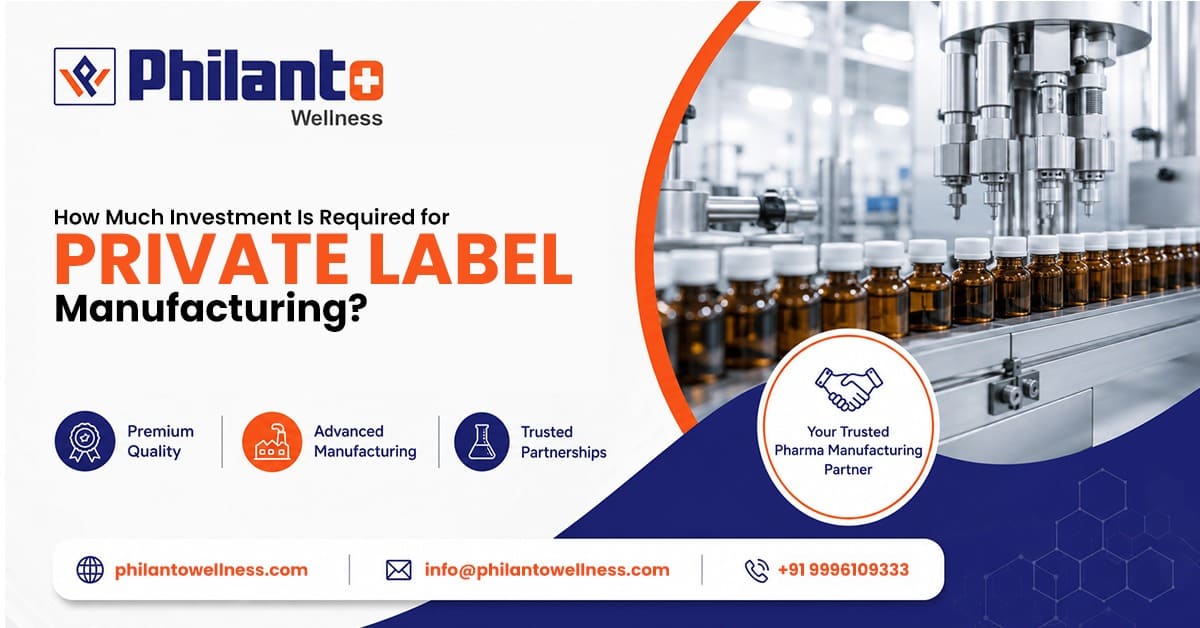
Private label manufacturing has become one of the most popular business ideas for entrepreneurs, startups, distributors, retailers, and brands. These services help them cover their needs, to launch their own items without building a manufacturing facility. If you want to step into the nutraceutical, cosmetics, food, pharmaceutical, personal care, or wellness industry, it’s important to understand the investment required for private label manufacturing. The actual Private Label Product Manufacturing Cost depends on things like the product category, the order amount, packaging requirements, how complex the formulation is, regulatory compliance, and the branding targets, basically your overall positioning.
Quick Answer
In India, the Private Label Product Manufacturing Cost usually sits around ₹50,000 to ₹10 lakhs or even more. But again it depends on the product kind, minimum order quantity (MOQ), packaging customization, label design, certifications needed, and yes marketing costs too. With this model, businesses can start with a relatively low budget if they partner with a seasoned private-label manufacturer that provides low MOQ and end-to-end support, like a smooth one stop process.
What is private label manufacturing?
In the private label model, one manufacturer cranks out products under someone else’s brand name, and it feels like you’re the one who made it, even though you’re not.
- Like, a nutraceutical producer makes protein powder, y’know.
- Then the item gets packed up with your brand name, and also the logo on top of that.
- You market and sell the product as your own brand.
- Consequently, this arrangement allows businesses to focus on branding, sales, and distribution while the manufacturer handles production and quality control.
Key Factors That Affect Private Label Product Manufacturing Cost
Private label manufacturing has become a preferred business model for companies trying to launch their own branded products without really putting money into manufacturing facilities. However, the overall manufacturing cost for private label products can fluctuate significantly due to various factors. When businesses understand these drivers, they can decide more wisely, keep budgets under control, and usually lift profit margins too.
1. Raw material quality and where it comes from
The quality , availability, and the sourcing route of raw materials really do push manufacturing costs very directly. Like if a company goes with premium-grade ingredients, specialized compounds, or imported materials, well then those usually cost more compared to standard alternatives , basically no surprise.
Things to think about :
- Ingredient quality benchmarks
- How steady the supplier stays
- Price swings in the raw material market
- Whether specialty ingredients are easy to find in practice
2. Product formulation complexity
In general, simpler formulations tend to be easier and cheaper to manufacture than products that carry multiple active ingredients, or a more unique recipe. And when you customize the formulation it can add extra steps, like extra research, testing, and development happening in the background. Costs also often rise if there are complicated ingredient pairings (or combinations), plus specialized manufacturing procedures. You might also see extra time spent on stability and compatibility checks, and innovation has to match the product concept, not just exist on its own.
- Complicated ingredient pairings or combinations, which can be challenging to manage in practice.
- Specialized manufacturing procedures that require precise execution at every step.
- Additional stability and compatibility testing beyond basic quality checks.
- Innovation requirements that remain aligned with the original product concept.
3. Production volume, or run size
The number of units produced has a strong effect on manufacturing costs. If the runs are bigger, the per-unit cost usually drops, because economies of scale kick in, it’s kind of like spreading setup effort across more units. Higher production volumes can help with :
- Lower per-unit manufacturing expenses
- Better pricing on bulk raw materials
- Less setup cost per batch
- Smoother operations overall
4. Packaging requirements
Packaging often becomes a big chunk of private label manufacturing spend. The packaging type, the design, the materials, and how much customization is requested can move the final budget quite a bit, even if the product itself stays the same.
5. Regulatory Compliance and Certifications
Before a product can enter the market, it must meet industry rules and quality expectations in a tangible manner. Usually this means there are several compliance obligations; testing goes first, then documentation, then certification-related expenses that do add up.
Estimated Investment for Private Label Manufacturing
| Business Scale | Estimated Investment Range |
|---|---|
| Small Startup Launch | ₹50,000 – ₹2 Lakhs |
| Regional Brand Launch | ₹2 Lakhs – ₹5 Lakhs |
| Multi-Product Brand | ₹5 Lakhs – ₹10 Lakhs |
| National Scale Brand | ₹10 Lakhs and Above |
Common Challenges Businesses Face while Deciding Private Label Manufacturing Startup Costs
1. Figuring out Product Creation Costs
Private Label Manufacturing Startup Costs – Many companies have a hard time getting a clean estimate for formulation, testing, sampling, and design expenses, so budgets can quietly go up, or in other words, show up bigger than expected, sometimes with almost no warning.
2. Understanding Minimum Order Quantities
When the minimum order amount is high, it tends to raise that first investment, which then creates inventory pressure and a pretty real strain on cash flow for newer businesses.
3. Spotting the Stuff That Lurks in Manufacturing Expenses
There are extra costs, like packaging, labeling, compliance-oriented testing, logistics, and setup fees, that often only appear after you have already received the first quotation, so the “real” total finally shows itself later.
4. Managing the Cost of Regulatory Compliance
Permissions, certifications, product approvals, and the paperwork side—plus legal documentation—can push startup spending much higher than planned, even when everything looks straightforward at first.
5. Working Out Packaging and Branding Costs
Custom packs, premium materials, polished design choices, and branding elements usually demand a bigger budget than people think initially, especially when you also want consistency across channels.
Private Label Manufacturing vs. Setting Up Your Own Manufacturing Unit
| Factor | Private Label Manufacturing | Own Manufacturing Unit |
|---|---|---|
| Initial Investment | Low to Moderate | Very High |
| Manufacturing Infrastructure | Not Required | Required |
| Machinery & Equipment | Not Required | Significant Investment |
| Regulatory Compliance | Shared with Manufacturer | Fully Managed by Owner |
| Time to Market | Fast | Long Setup Period |
| Product Development | Easier | Requires In-House Expertise |
| Operational Complexity | Low | High |
| Inventory Risk | Lower | Higher |
| Production Control | Moderate | Complete Control |
| Scalability | Easy and Flexible | Capital Intensive |
| Business Risk | Lower | Higher |
| Suitable For | Startups, SMEs, New Brands | Large Established Businesses |
For most startups and emerging brands, private label manufacturing offers a faster and more cost-effective route to market.
How to cut down your Cost of Starting Private Label Manufacturing
You might want to keep a few things in mind , because honestly the early costs can feel a bit wild. A good approach is to use strategies like these:
1. Start with one hero product
Pick just one high-demand item first , and don’t jump everywhere at once. Once it sells steadily then you can broaden the lineup.
2. Choose an experienced manufacturer
Working with a reliable production partner can reduce mistakes, slowdowns, and all those “hidden” expenses that show up later.
3. Use standard packaging at first
Try not to overpay for fancy, premium packaging during the launch phase. Keep it simple until you know customers are actually buying.
4. Test market demand first
Before you lock in big inventory purchases , validate real interest from buyers. It saves a lot of money , and it also avoids sitting on stock.
5. Build a gradual product portfolio
Don’t rush into lots of SKUs. Add new items only after you see consistent sales.
What should you ask a private label manufacturer before investing?
Before you finalize anything, ask questions like:
- What’s your minimum order quantity?
- Can you make custom formulations available?
- What certifications do you currently have?
- What kind of packaging options can you offer exactly?
- What production timeline do you usually follow?
- Do you also help with label design assistance?
- Are testing and quality assurance included?
- What support is available for startups?
Ultimately, these questions can especially help prevent unexpected costs and operational issues in the Cost of Starting Private Label Manufacturing.
Why Philanto Wellness feels like the right choice for cost-effective private label product manufacturing
Picking the Private Label Product Manufacturing Cost is one of those decisions that actually matters a lot for most startups, distributors, retailers, or brand owners. Sure, the manufacturing cost is a big deal, but it’s not the only thing people care about. There’s also quality that doesn’t wobble, regulatory compliance that’s ready for real life, flexible MOQs, and day-to-day operational support that doesn’t leave you hanging.
Additionally, Philanto Wellness comes up as a dependable private label manufacturing partner because it offers cost-friendly solutions that still protect product quality, allow customization, and support business growth. You get savings and stability, which many teams need later. Consequently, If you’re building a fresh wellness brand, or if you’re adding to an existing lineup, Philanto Wellness helps you fine-tune manufacturing costs. Along with these services, we are always ready to assist our clients to push for quicker market entry and long-term scalability.
Key Reasons Philanto Wellness Works for Private Label Manufacturing
- Competitive Manufacturing Costs:
Cost-effective production options that help you protect or grow profit margins without giving up product standards or consistency. - Low Minimum Order Quantities (MOQs):
Startup-friendly manufacturing paths that cut down upfront investment and lower inventory risk, allowing businesses to begin with smaller production volumes. - Broad Portfolio of Offerings:
Private label manufacturing solutions for nutraceuticals, protein powders, dietary supplements, wellness products, herbal formulations, and related health-focused categories. - Premium Quality Standards:
A strong commitment to high-quality ingredients, rigorous quality checks, and manufacturing processes that comply with industry regulations and standards. - Custom Formulation Support:
Assistance in developing unique formulations tailored to your target market’s needs, brand objectives, and product positioning requirements.
Conclusion
In short, the Private Label Product Manufacturing Cost depends on your product category, order volume, customization needs, and your business direction. Some brands can begin with an investment around ₹50,000–₹2 lakh, but for bigger launches you may need a lot more budget. For most entrepreneurs, private label manufacturing is a low-risk, cost effective way to build a brand without putting money into expensive manufacturing facilities. When you pick the right partner, keep inventory handled properly, and push strategic growth, firms can launch smoothly while keeping that first investment as light as possible.
Frequently Asked Questions (FAQs)
Q1. What is the minimum investment needed for Private Label Product Manufacturing Cost?
A1. Most manufacturers have options that feel more startup friendly , and it can start around ₹50,000 in many cases, but it depends a lot on the product segment and on the MOQ.
Q2. Is private label manufacturing profitable?
A1. Yes , private label products tend to give better profit margins because you can manage branding , pricing, and how you position yourself in the market.
A3. Can I start a private label brand without owning a factory?
A1. Yes indeed. Private label manufacturing lets you launch and sell items under your own brand name, without needing to set up a production unit first.
A4. What factors impact the Private Label Manufacturing Startup Cost?
A1. The main things are formulation, raw material quality, packaging, branding , certifications, testing, and also the quantity of the order.
A5. Is private label manufacturing better than building my own manufacturing unit?
A1. For new businesses and growing brands, private label manufacturing is usually more economical, quicker to launch, and generally less risky than starting a facility from zero.